Why are so many commercial loans coming due right now?
Commercial real estate is in the middle of a heavy refinancing season. According to Trepp's October 2026 hard-maturity analysis, $76.6 billion of commercial mortgage-backed securities (CMBS) loans reach hard maturity in 2026, more than either of the two prior years, and the schedule is back-loaded: 39% falls in the fourth quarter alone. Trepp also found that 36% of those loans have a debt yield at or below 8%, the range it identifies as most likely to face refinancing friction, with office, retail and multifamily carrying the highest concentration.
A "hard maturity" means the loan has no extension options left. The borrower has to repay or negotiate. CMBS loans are only one slice of the market, and many North Florida properties are financed through local banks, credit unions or private lenders instead. Still, the pattern matters locally: when a lot of loans mature at once, lenders get more selective, and the physical condition of a building becomes part of the conversation sooner.
What does a lender look at besides the numbers?
Income, occupancy and debt yield get the headlines, but lenders also want to know what the building is going to cost to keep running. Depending on the loan, that review may include:
- Immediate repairs that affect safety, building function or code-related concerns.
- Deferred maintenance such as worn roofing, failing sealants, cracked paving or aging water heaters.
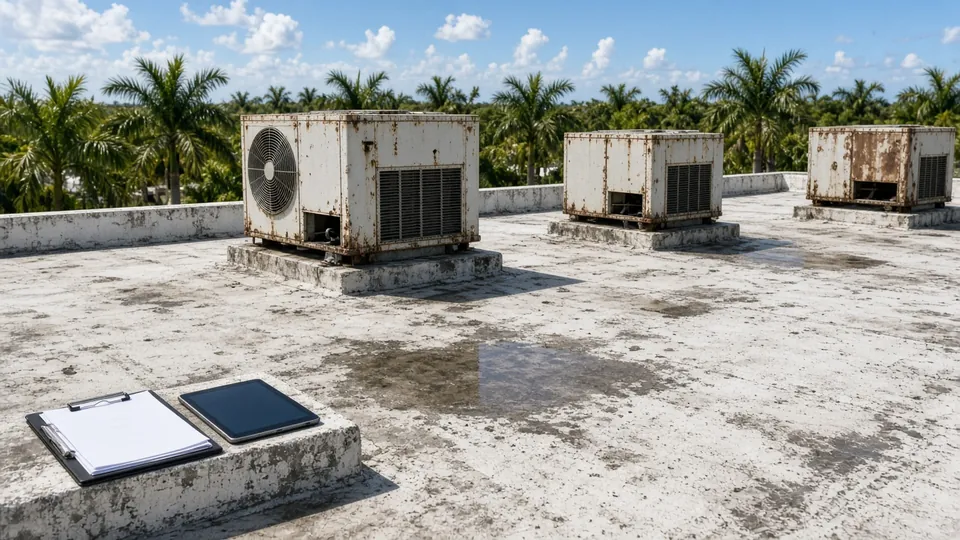
- Short-lived components that will need replacement during the loan term, such as rooftop HVAC units, roof coverings and parking lot surfaces.
- Reserve requirements, the money set aside each year for future capital work.
Many lenders order their own third-party report for this. Requirements differ by lender and loan program, so ask early whether they will accept an owner-commissioned report, need to be named as a reliance party, or will engage their own consultant. Either way, the owner who already knows what is on the roof is in a much better position than the owner who learns about it from the lender's report.
Why find the repair costs before the lender does?
A surprise in a lender's condition report can change a refinance timeline quickly. A roof nearing the end of its service life, several aging HVAC units or a parking lot that needs resurfacing can show up as an immediate repair item or a larger reserve. When you know about these items ahead of time, you have options:
- Fix smaller items first. Sealant failures, damaged flashing, trip hazards and minor plumbing leaks are often less expensive to correct before a lender's visit than to explain afterward.
- Gather the records. Roof warranties, HVAC service records, permit history and recent invoices help support the remaining-life estimates in any condition report.
- Budget for what is coming. If replacements are likely over the next several years, you can plan the cash instead of being surprised by a reserve requirement.
- Have better-informed conversations. You, your broker and your lender can discuss the property from the same set of facts.
What a condition report cannot do is promise an outcome. Loan approval, rates, terms and reserves are the lender's decision, based on its own underwriting.
What a Property Condition Assessment covers
Our Scope 4 — Property Condition Assessment is the most detailed of our four inspection scopes and is built for acquisition, portfolio and lender-related due diligence. Within the agreed scope, it includes:
- A full commercial building inspection of visible and accessible areas: site, structure, building envelope, roofing, HVAC, electrical, plumbing and interiors.
- Available document review and interviews, as defined in the agreement.
- Opinions of probable cost for immediate repair concerns.
- A ten-year capital reserve outlook.
- A detailed accessibility review of visible and applicable measurable elements within the agreed scope.
- An executive summary, a prioritized deficiency list, photo documentation and a detailed Property Condition Report.
When a lender has specific instructions, such as ASTM E2018-24 methodology or reliance language, send them with your proposal request so the scope can be confirmed in writing before the assignment. Cost figures are planning-level opinions, not contractor bids. See what a commercial inspection report includes.
Do you need the full PCA?
Not always. If a full PCA is more than the situation calls for, Scope 3 — Commercial Inspection + Five-Year Capital Planning provides a full inspection with immediate repair cost opinions and a five-year reserve outlook. It can be a good fit for smaller properties or for owners who want an internal planning document rather than a lender-facing report.
Refinancing in North Florida: local conditions to plan for
Our team inspects commercial buildings across Tallahassee, Jacksonville, Gainesville, Lake City, Ocala and the surrounding region. Some conditions come up again and again in this climate:
- Roofs and rooftop equipment. Heat, UV exposure and summer storms are hard on low-slope roofs and the HVAC units sitting on them.
- Water management. Heavy rainfall puts pressure on gutters, downspouts, paving slopes and building envelopes. Our guide to drainage warning signs covers what to watch for.
- Older office and retail buildings. Many mid-century and 1980s buildings in the region have systems that have been repaired in pieces over the years, which makes remaining-life estimates more important.
- Trees and site features. Live oaks are part of the region's character, but roots and limbs can affect paving, sidewalks, roofs and drainage.
A refinance-ready checklist for owners
- Confirm your maturity date and ask your lender or broker what third-party reports the new loan will require.
- Gather roof, HVAC, fire-protection and elevator service records, warranties and any prior inspection reports. Our seller document checklist is a useful starting list.
- Book the condition assessment early. Most commercial inspection reports are delivered within 3–5 business days after the inspection, but detailed PCAs and larger properties may take longer.
- Decide which items to repair now and which to budget for.
- Keep the report and repair invoices together so you can answer the lender's questions quickly.
For more on how cost planning supports long-term decisions, read why adding cost forecasting to a commercial inspection pays off, and see what affects commercial inspection and PCA fees.
Frequently asked questions
Will a Property Condition Assessment help me get my loan approved?
No report can guarantee approval, rates or terms. Those are the lender's decisions. A PCA helps you understand your building's repair needs and future capital costs in advance, so you can plan, repair or gather records before the lender's own review.
Will my lender accept a PCA I order myself?
It depends on the lender and loan program. Some lenders accept an owner-commissioned report, some require reliance language, and many order their own. Ask your lender first and send us their requirements with your proposal request.
How far ahead of a refinance should I order a condition assessment?
As early as practical, ideally several months before maturity. That leaves time to schedule the inspection, receive the report, complete repairs and collect invoices. Reports usually arrive within 3–5 business days after the inspection, and detailed PCAs can take longer.
What is the difference between Scope 3 and Scope 4?
Scope 3 — Commercial Inspection + Five-Year Capital Planning includes a full inspection, immediate repair cost opinions and a five-year reserve outlook. Scope 4 — Property Condition Assessment adds document review and interviews, a ten-year reserve outlook, a detailed accessibility review, an executive summary and a prioritized deficiency list.
What areas do you serve for refinance-related assessments?
We serve commercial properties throughout Florida, Georgia and Alabama, including Tallahassee, Jacksonville, Gainesville, Lake City and Ocala.
Refinancing soon? Tell us about the property, your maturity date and any lender requirements, and we'll recommend the right scope.
Sources
Images in this article are AI-generated illustrations, not actual High Mark inspections or client properties. This article is general information and does not replace the written scope in your inspection agreement.